best ui/ux, mlh x digitalocean10 to 11 jul 2026
wavelength
a consented co-pilot that reads conversation cues live and debriefs afterwards.
private repo, no public link
live view raising a hedged nudge
- eventai for social good: hack with mlh & digitalocean
- when11 jul 2026
- built inabout 2 days of commits
- teamteam of 4
the problem: in a live conversation, plenty of people can't tell how the other person is taking it, and nobody tells you afterwards what went wrong.
wavelength is a consented co-pilot for that. it watches observable signals (face, voice, pulse), sends a short hedged nudge while you talk, then gives you an annotated timeline and a debrief.
the rule we built around: it suggests, it never diagnoses. every read carries a confidence level and can be wrong on purpose.
the hard part was the "when". we kept the nudge timing in plain deterministic code on the laptop, and let the language model only phrase it.
it shipped as one deployable app on digitalocean, with an offline fallback so a dead wifi connection on stage can't kill the demo.
it won best ui/ux at the mlh x digitalocean hackathon in san francisco, 10 to 11 jul 2026.
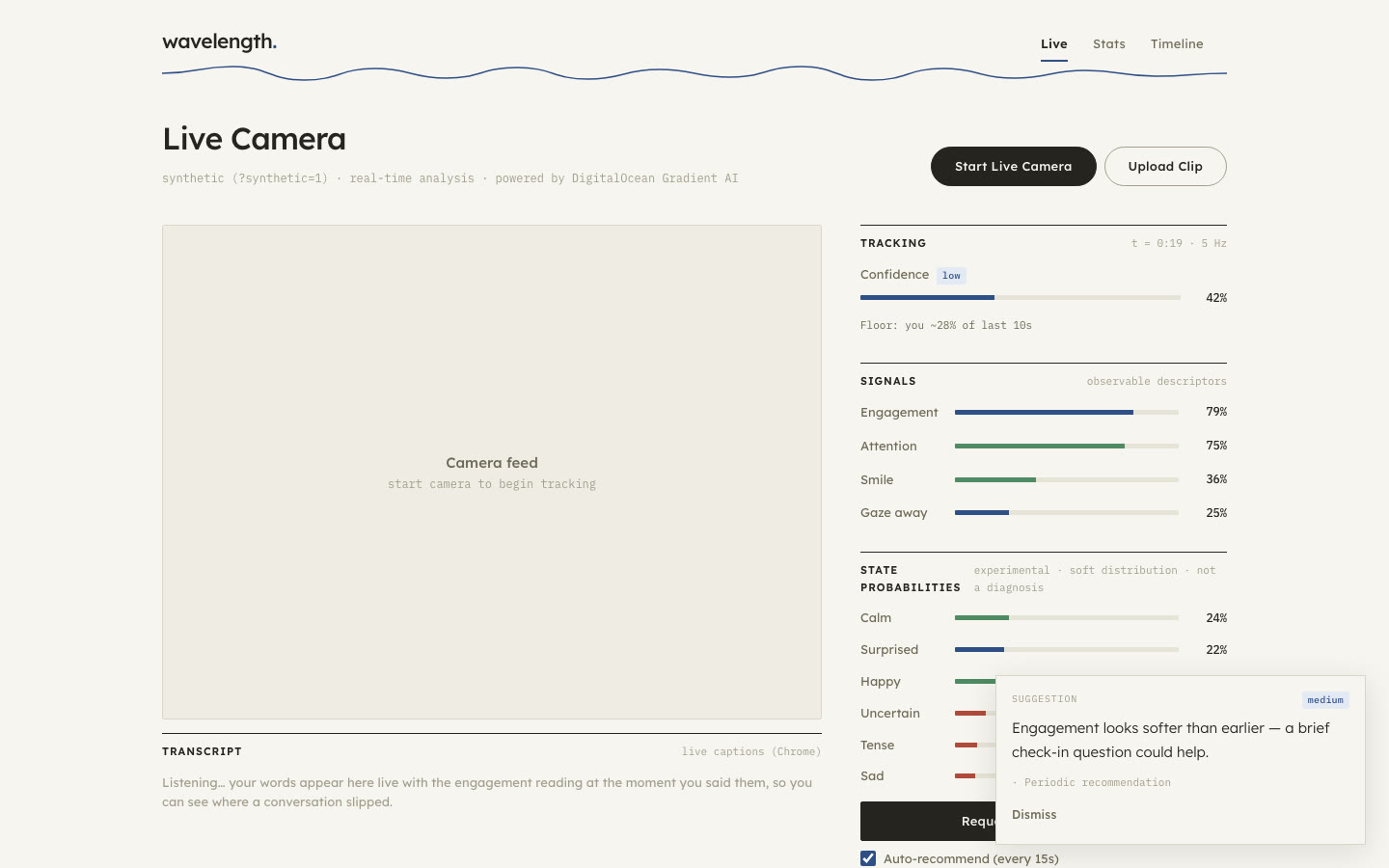
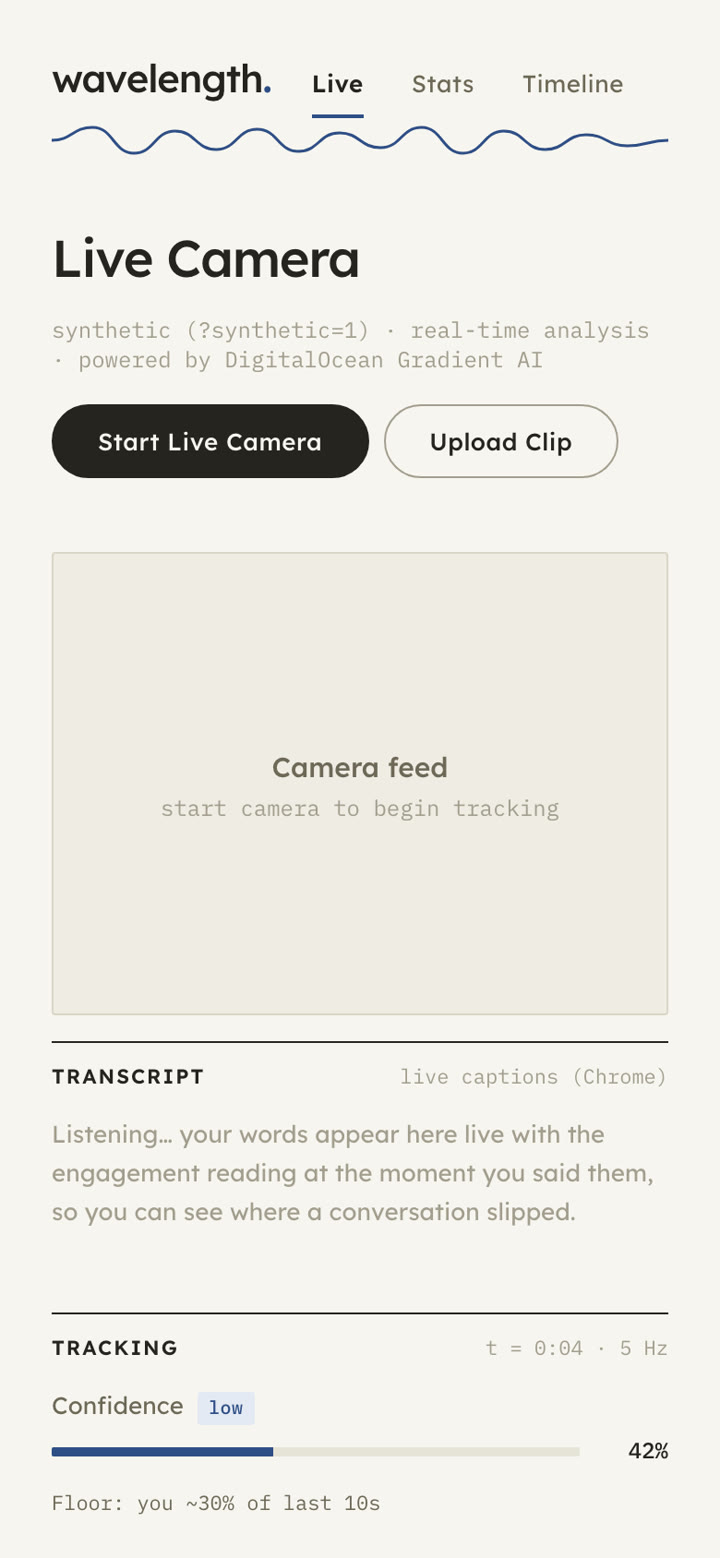
- three states in one page: consent, live, debrief. raw video stays on the laptop; only derived signals and transcript text go to the cloud (stated in the app's own privacy copy).
- perception runs in the browser: MediaPipe face tracking gives smile, brow, eye and gaze signals at 5 Hz, which become an engagement score and soft emotion probabilities (calm, happy, tense and so on, labelled experimental, not a diagnosis).
- a pulse channel: remote photoplethysmography (rPPG) recovers heart rate from the colour of a skin patch over a 10 second window, tagged with an SNR-based confidence, so a face that looks calm but a body that spikes can surface as "the tell".
- the nudge trigger is deterministic: engagement z-score against a moving average, a sustained dip of 10 s, a 15 s cooldown. the server only phrases the hedge.
- server is TypeScript/Express with a Zod contract shared by client and server, Postgres through Drizzle, and an LLM wrapper on DigitalOcean Gradient with forced tool-calling, schema validation and one repair retry. the debrief streams over SSE, and canned fallbacks cover model failure.
- deployed by Docker on DigitalOcean App Platform with managed Postgres, a rate-limited /v1 API and a migrate-on-start entrypoint.
- 162commits on the default branch, 161 of them 10 to 12 jul 2026
- 4git authors (60, 54, 47, 1 commits)
- about 7,500lines of TypeScript across client, server, shared
- 48test cases in 11 test files; 37 of the 39 that ran offline passed at HEAD (2 fail in server moments tests), the rest are integration tests needing the live database
- 74models in the DigitalOcean catalog probed in the backend spike; fast tier Claude Haiku 4.5, smart tier Claude Sonnet 4.6
- result: Best UI/UX